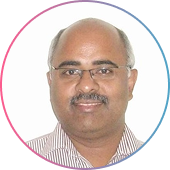
Mr. Paul Mathew
Founder & CEO of Nethram LLC
Session: Solutions for Man-Animal Conflict – a Wholistic Approach
Paul Mathews is a technology entrepreneur, legal advocate, and human-rights activist whose work has had a significant impact on addressing human–wildlife conflict in Kerala. He is the Founder & CEO of Nethram LLC and Managing Director of Nethram India Innovation Center, a software company he built from scratch, growing it to a 20-member team with operations in the U.S. and Wayanad.
Before turning to public-interest work, Paul spent over a decade in leadership roles at Ericsson across the United States, Sweden, and India, where he managed large engineering teams, led innovation programs recognized by Ericsson’s CEO, and directed strategic technology initiatives that saved the company hundreds of millions of dollars annually.
His shift toward activism began after witnessing the tragic consequences of wild animal attacks on tribal communities in Wayanad. Since then, he has become a leading voice in Kerala on issues of elephant and tiger conflicts, crop destruction, and farmer safety . His legal interventions have contributed to landmark hearings in the Kerala High Court and Supreme Court of India, including:
- A Public Interest Litigation that resulted in the High Court constituting a special bench every Wednesday to monitor wildlife conflict at Aralam and directing him to lead a multi-institutional task force with IIM Kozhikode and NIT Calicut;
- High-impact applications in the Supreme Court related to tiger incursions and the NH-766 night-traffic restrictions affecting Wayanad farmers;
- Multiple writ petitions addressing farmer protection, disaster relief, and environmental governance.
Under his leadership, the Aralam Task Force grew to over 100 members and produced 131 actionable recommendations, most of which were accepted by the district administration. His work has empowered marginalized communities—particularly tribal residents—to demand accountability from the state and participate in policy-making for wildlife safety.
Paul holds a B.Tech from IIT Madras, MS and MBA from the University of Colorado Boulder, and an LLB from Karnataka State Law University. He has argued cases as a party-in-person at both the High Court and Supreme Court of India, earning a reputation as a champion of human rights and a tireless advocate for the safety of farmers and rural communities affected by wild animal attacks .
He continues to integrate technology, law, and community engagement to develop practical solutions—including wildlife-monitoring software, elephant alert devices, and field-based task force models—to reduce human–wildlife conflict and protect the livelihoods of farming communities across Kerala.